
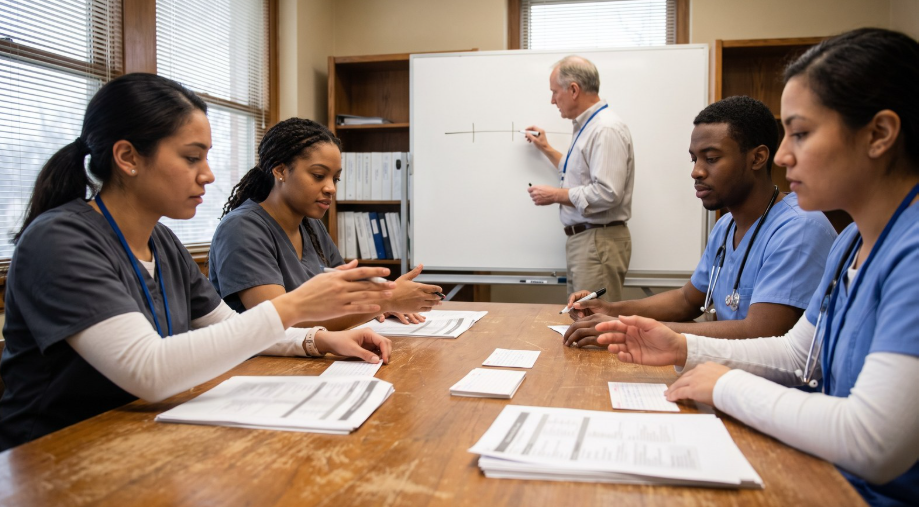
Start with the patient, not the question format. That’s my advice to colleagues planning NGN preparation. A clever item type on a thin scenario gives students little to think about. A well-built case gives them something to notice, weigh and decide, whatever format the questions take.
What NCSBN says the exam is doing
On its NGN overview page, NCSBN states that the Next Generation NCLEX launched on April 1, 2023, to better measure candidates’ clinical judgment and decision making through innovative item types. It says the need came from the 2013 to 2014 NCSBN Strategic Practice Analysis, which showed that newly licensed nurses are increasingly expected to make complex decisions while caring for patients. The same page describes the NCLEX as using real-world case studies.
So one reasonable way to prepare students is to practice with cases. What follows is a proposed teaching approach, laid out as a hypothetical case that unfolds in stages, the way a case in class could.
0800: the baseline
Imagine a patient on post-operative day one. At 0800 the chart shows a stable temperature, a heart rate in a comfortable range, a pain score the patient calls manageable and a dressing that is dry. Give students only this. Ask them to say what they would expect to see and what they would keep watching.
Keep the data short. Three or four findings are enough, because the aim is for students to form a picture they can compare against later.
1000: something changes
Now add the next set of information. The heart rate is higher, the pain has moved to a new place and the dressing has more drainage than before. Nothing here needs a rare diagnosis. Students need a change they can notice, name and act on.
This is the part of the case that carries the teaching. An evolving case gives students practice responding to changing information, which is a different skill from recalling a fact about a condition. If your class has only one hour, I’d spend more of it here than on the baseline.
Mapping the questions to the model
NCSBN developed the Clinical Judgment Measurement Model (NCJMM) as a framework for measuring clinical judgment. Its model page explains that layer 3 outlines the cognitive aspects of clinical decision making that are directly measurable, and that these are the basis for developing test items and case studies for the exam. Those layer 3 skills are recognizing cues, analyzing cues, prioritizing hypotheses, generating solutions, taking actions and evaluating outcomes.
You could give each skill one prompt in the 1000 stage. Which findings are new? What could explain them? Which explanation is most urgent? What would you want to try first? What would you do, and how will you know whether it worked?
NCSBN also offers Clinical Judgment Skills Cards for the layer 3 skills, available for personal and educational, non-commercial use, so read the terms on the page before copying anything into course materials.
Letting students answer in different ways
You don’t have to copy every exam format on paper. A few classroom adaptations are possible: asking students to select every finding that matters, to circle the sentence in a nurse’s note that changed their reasoning, or to put four actions in order. These are suggestions of my own and not official NCSBN formats. The goal is the same each time, which is to make students commit to their reasoning and not only to a letter.
Where a platform can sit alongside this
Some faculty also look at Lecturio for nursing schools, a platform whose nursing page lists video lessons, NCLEX preparation and clinical judgment among its features. Whether you use a platform or paper, the case design described here is work for the faculty member to do.
1030: the debrief
After the answers, ask two questions. Which cue changed your mind? What would you have done if that cue had been missing? A student who reached the right answer for the wrong reason needs that conversation more than a student who missed it for an honest one. Keep your own answers short and ready, since students will ask what you would have chosen and why.
A caution about the model
NCSBN is clear on its model page that a nursing process underlies the NCJMM, that the model was not built to replace any nursing process model, and that good instruction using any such model gives a solid foundation for an exam measuring clinical judgment. There is no need to discard the framework your program already teaches. The NCJMM can sit on top of it as a way to see where each question in your case belongs.
For background on how the item writing itself works, NCSBN’s 2019 article Building a Method for Writing Clinical Judgment Items for Entry-Level Nursing Exams describes the licensure exam’s process for measuring clinical judgment in entry-level nursing.
So here is a question to take to your next course meeting. Which case in your current lecture notes already has a patient who changes, and could you split it into two time points by next week?
Notes for the editor
Suggested meta description: How nurse educators can build unfolding class case studies that mirror Next Generation NCLEX clinical judgment items, using the NCSBN clinical judgment model.
Featured image alt text: Nursing students at a seminar table study printed patient charts while their instructor writes a timeline on a whiteboard.